

Card vs. ACH Donations:
Understanding the Cost Difference
By Matthew Culp
A church finance committee is reviewing $1,000 in online giving. Someone asks, “What would the processing cost be if those payments came through ACH instead of cards?”
Before reaching for a percentage, the treasurer checks one more number: how many payments make up that $1,000?
That detail matters. Ten payments of $100 and one payment of $1,000 add up to the same giving total, but a fixed fee applies to each electronic payment. A useful comparison keeps both the giving amount and the payment count the same.
Let’s work through an illustrative example you can adapt for your church. These are processing-fee calculations, not customer results or a forecast of money reaching a bank account.
Start with ten payments of $100
For this example, assume all ten payments complete successfully, no donor adds an optional contribution toward fees, and there are no refunds, chargebacks or rejected payments.
Our card processing rate is 1.88% plus $0.30 per electronic payment. Our ACH processing fee is $0.30 per electronic payment. ACH means a payment drawn from a bank account.
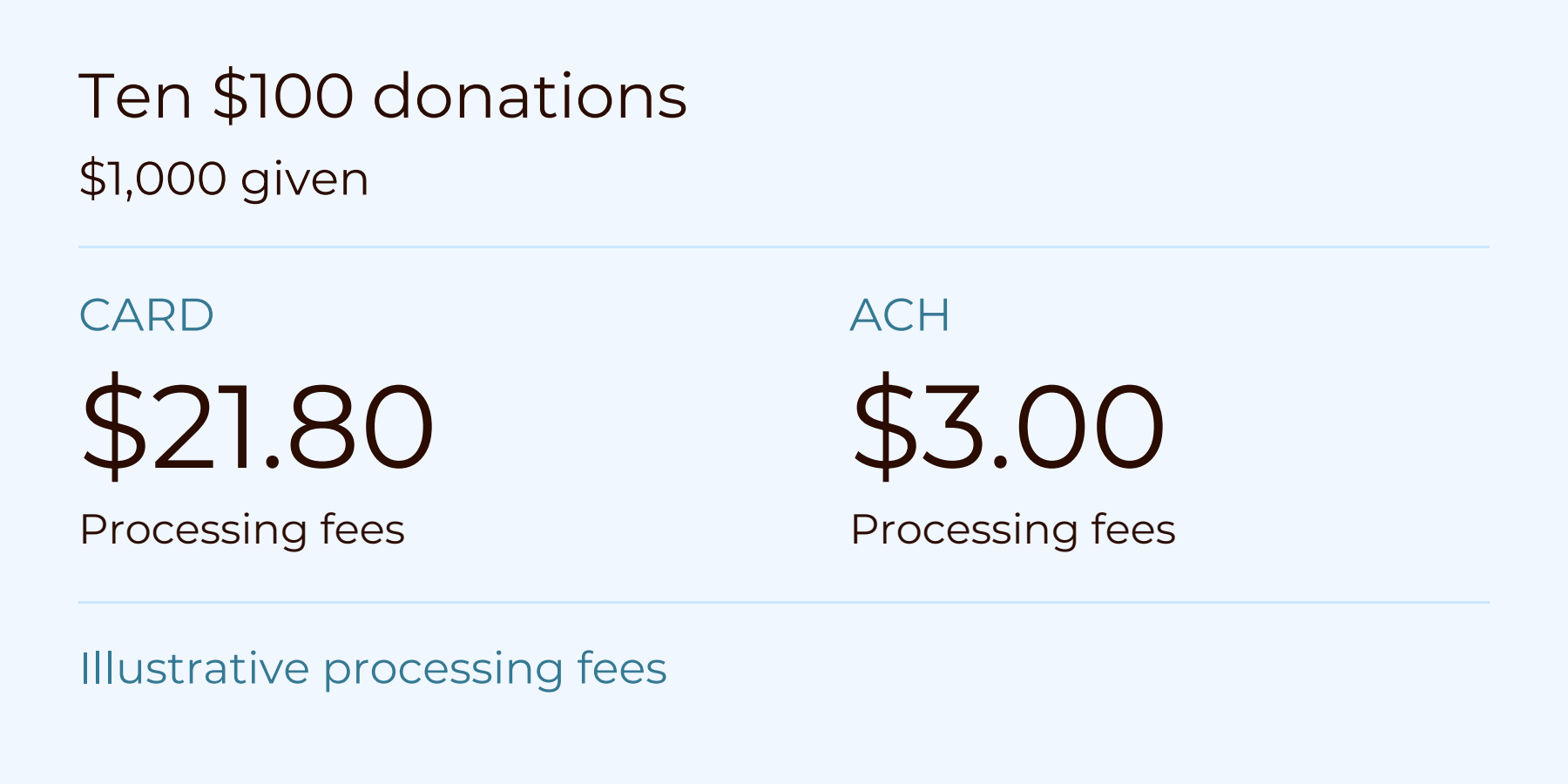
For one $100 card payment, the percentage portion is $1.88. Add the $0.30 fixed fee, and the processing cost is $2.18. Ten such payments cost $21.80 to process.
For ten $100 ACH payments, the calculation is ten times $0.30, or $3.00. The difference in processing fees is $18.80 for these ten payments.
| Same giving, same payment count | Card | ACH |
|---|---|---|
| Number of payments | 10 | 10 |
| Amount per payment | $100 | $100 |
| Total giving | $1,000 | $1,000 |
| Processing fee per payment | $2.18 | $0.30 |
| Total processing fees | $21.80 | $3.00 |
The comparison answers a specific question: what does it cost to process the same ten payments using each method? It does not tell the committee that all donors will choose ACH or that every month will look like this example.
See what changes when the payment count changes
Now suppose the $1,000 arrives as one payment. The card calculation is $18.80 plus one $0.30 fee, totaling $19.10. The ACH fee is $0.30.
| Same giving, different payment counts | Card fees | ACH fees |
|---|---|---|
| One payment of $1,000 | $19.10 | $0.30 |
| Ten payments of $100 | $21.80 | $3.00 |
The percentage portion of the card cost stays $18.80 in both examples. The total fixed fees rise from $0.30 to $3.00 because there are nine additional payments. Since both methods have the same $0.30 fixed fee, the card-versus-ACH difference remains $18.80 in these examples.
This is why a giving total alone is not enough to calculate the full processing cost. The number of payments changes the total even when the amount given stays the same.
Build a comparison from your own month
Choose one completed month and record the total amount and number of successful card payments. Then record the same two figures for ACH. Keep the methods in separate rows so the committee can see the actual mix.
For a simple estimate at these rates, multiply the card amount by 0.0188, then add $0.30 for each card payment. For ACH, multiply the payment count by $0.30. Check the result against the actual fee records; per-payment rounding can affect a total calculated from a whole month at once.
If you want to explore a different mix, state the assumption clearly. For example: “What if ten $100 card payments were made by ACH?” Use the same ten payments in both columns. Do not treat that scenario as a commitment from donors or an annual savings result.
Compare card and ACH costs
Start with the editable sample values below, or enter your own total and donation count. Results update automatically for the same donations paid by card or ACH. All amounts are in US dollars.
- Estimated card cost
- —
- Estimated ACH cost
- —
- Difference in processing costs
- —
Enter amounts to calculate your comparison.
Card: 1.88% of total donations plus $0.30 per donation. ACH: $0.30 per donation. Estimates exclude optional fee contributions, refunds, chargebacks and rejected payments. Actual fees may differ because of per-donation rounding. This is not a deposit forecast. Your entries are not saved or submitted.
Please enable JavaScript to use this calculator. No result is calculated while JavaScript is disabled.
Keep other costs and donor choice in view
This example covers ordinary processing fees only. We have no monthly platform fee. Refunds cost $0.30 per transaction with no percentage-based refund fee. Chargebacks and rejected ACH payments cost $35 each. An outbound payment-token transfer has a separate $500 pass-through cost without markup; contact us to confirm eligibility and timing before planning a transfer.
Keep those items separate when reviewing actual costs. See the villaDeus Terms of Service for applicable terms and conditions.
What if a donor contributes toward fees?
An optional contribution toward fees changes who funds the cost; it does not make processing free. Keep the donor’s intended gift, the total payment processed and the processing fee as separate figures. If the total card payment increases, the percentage-based fee also changes. Use the actual payment and fee records rather than assuming that an added amount exactly covers the fee. The examples and worksheet here exclude these optional contributions.
A lower fee can be useful information without becoming pressure on a donor. Explain the available giving methods plainly, answer questions, and let people choose the method that works for them.
Bring the committee a comparison it can follow: the same giving amount, the same payment count, clear assumptions and a separate list of exceptions. That makes the discussion easier to check—and more useful than a percentage on its own.
Talk through your church’s giving costs
Bring your giving totals and payment counts to a conversation about the costs and reporting your finance team needs to understand. You can also explore villaDeus Giving.
Please do not send donor records or bank details through the consultation form.