

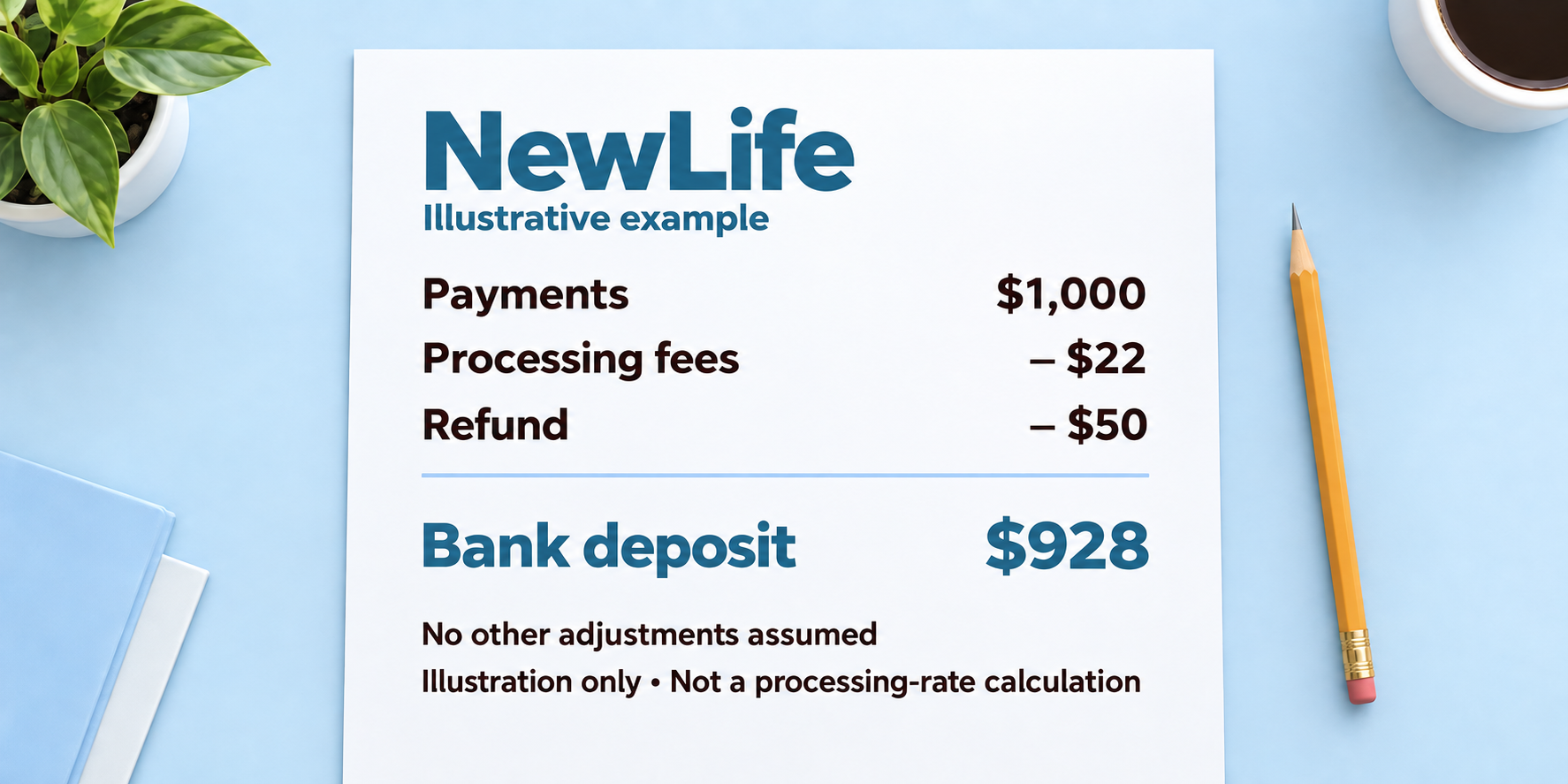
Imagine you help with the finances at NewLife, a fictional church for this example. You see $1,000 in electronic payments, but only $928 has arrived in the bank. That leaves a $72 difference to explain. Was it all taken in processing fees, or does the deposit include something else?
To find out, follow that one deposit from the payments listed in the giving report to the amount received by the bank.
First, check which payments belong to the deposit
Before treating $1,000 as the expected deposit, NewLife’s team checks that those payments belong to the $928 bank deposit. They match the bank and giving-provider records using the deposit reference, account, currency and amount, and check the dates.
That matters because a payment can happen on one date and reach the bank on another. A giving total for a date range may include payments that belong to different deposits. Comparing two totals for the same week would not, by itself, explain the difference.
For our example, the matching deposit report confirms $1,000 in payments. NewLife now knows it is checking the right group of payments. The next step is to see what was deducted.
In villaDeus, we organize giving reports mainly around Bank Deposits. A Bank Deposit records money sent to your church’s bank account and can include several electronic payments, called Transactions. Start with that deposit’s report or export when checking money received by your bank. A donor’s Giving Statement records their Gifts toward charitable purposes; it is not the record for explaining this bank deposit.
Find the two amounts behind the $72 difference
NewLife’s deposit report shows $22 in processing fees and a $50 refund deducted from the payments. For this illustration, there are no donor contributions toward fees, additional charges, held funds or other adjustments.
The calculation is:
$1,000 in payments − $22 in processing fees − $50 refunded = $928 deposited.
That matches the bank. The full $72 difference is now explained: $22 paid for processing, and $50 was returned to a donor. Calling all $72 a processing fee would overstate the processing cost by $50.
These figures are invented to explain the report, not taken from a customer’s records. The $22 is an assumed fee amount, not a calculation using our processing rate.
Keep the refund separate from the processing cost
NewLife can now explain both the amount received and the processing cost. Its notes should keep the $22 fee and the $50 refund on separate lines so the next person can follow the same calculation.
The team should also keep the record supporting the refund. With villaDeus, a later refund does not change the original Bank Deposit report. It appears in the deposit from which the money is deducted. The same applies to a chargeback—money taken back through a payment dispute. If NewLife’s $50 refund relates to an earlier payment, that earlier record helps explain the deduction in this deposit.
A refund and any fee connected with that refund are separate amounts. Our example assumes no additional charge; your church should use the amounts actually shown in its records.
Use the same steps for your church’s deposit
NewLife’s question was specific: why did $1,000 in payments become a $928 bank deposit? Matching the records and separating the two deductions answered it.
For your own deposit, confirm which payments are included, then list each addition or deduction separately. If donors contribute toward fees, check whether those contributions are already included in the payment total before adding them again. Keep the total processing cost distinct from the amount your church pays.
If your calculation still does not match the bank, keep the difference as an open question. Check unclear labels and supporting records with your provider rather than treating the unexplained amount as another fee. Keep your deposit references and calculation together, and note who will follow up. Share donor or payment details only through an approved support channel and only as needed.
Once the deposit is explained, you can review processing costs with the right figures. Read what your church’s giving rate actually costs or talk with us about your church’s reporting needs.